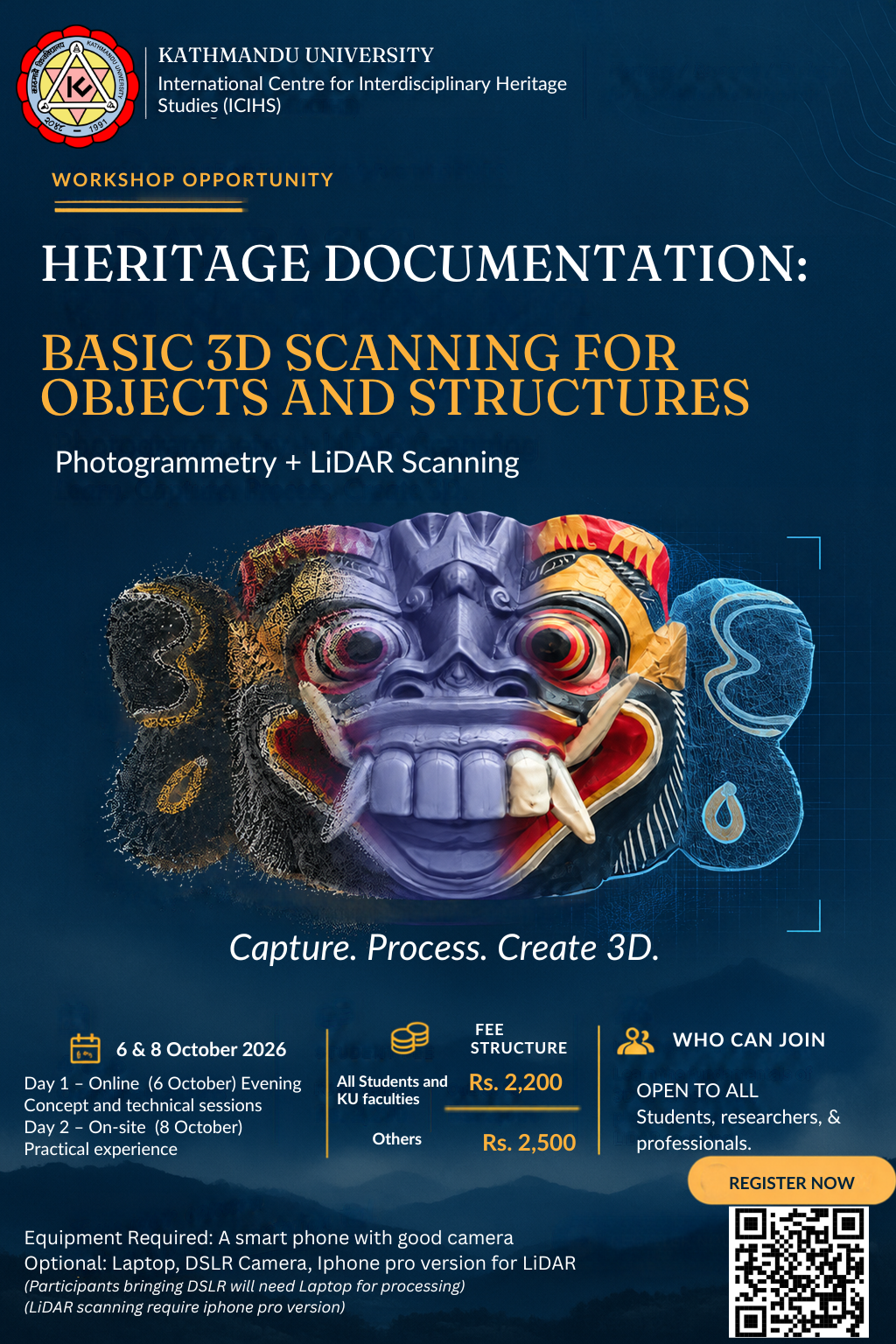
What if a series of ordinary photographs could become a 3D model or measurable digital record? In this workshop, participants learn the fundamentals of photogrammetry and apply them to a real-world subject.
No specialist background is required. Curiosity and a smartphone with a good camera are enough.
From photographs to form
See a photogrammetric result.
This rotating digital model demonstrates the kind of three-dimensional output produced by processing overlapping photographs of an object.
01 Photograph the object from multiple angles
02 Align and process the image set
03 Generate and review the 3D model
Final 3D object created using photogrammetry techniques.
Workshop programme
Two days, from principles to practice.
01
Online · Conceptual lectures
Tuesday Evening, 6 October 2026
Heritage documentation and digital methods
Photogrammetry, types and Structure from Motion
Applications in technical and non-technical fields
Photography, camera settings and image acquisition
Photogrammetric workflow, data and scaling
Introduction to LiDAR technology and scan data
02
Kathmandu University Premises, Dhulikhel · Demonstration and hands-on
Thursday, 8 October 2026
Photography tutorial and camera-setting experiments
Image acquisition and preparation
Photogrammetric data processing and 3D generation
LiDAR scanning exercise
LiDAR data processing and 3D generation
Online review and post-activity follow-up
What you will learn
Build a practical foundation.
01
Understand the basic principles of photogrammetry.
02
Plan a basic photogrammetric survey.
03
Capture photographs suitable for photogrammetry.
04
Generate 3D photogrammetric outputs.
The workshop does not include finished architectural outputs.
What to bring
Your smartphone is enough.
Mandatory: any smartphone with a good camera.
Optional equipment
Laptop
DSLR camera
iPhone Pro with LiDAR
Participants using a DSLR will also need a laptop for data processing. The LiDAR exercise requires an iPhone Pro.
Training fees
Simple fee structure.
Students (any institution) and individuals associated with Kathmandu UniversityRs. 2,200
Everyone elseRs. 2,500
Completion certificates will be awarded following submission of the post-workshop assignment. Minor prizes will be awarded based on assignment quality, performance and assessment score.
Who is this for?
No specialist background required. Curiosity is enough.
For anyone interested in capturing, documenting, measuring, mapping or digitally reconstructing heritage objects—including students, researchers, archaeologists, heritage enthusiasts and professionals.